

Evolution and Common Ancestry
Humans Did Not Evolve from Chimpanzees or Monkeys

A common misconception about Darwinian evolution is that humans descended directly from modern chimpanzees, monkeys, or apes. This is incorrect. The theory of evolution by common descent states that humans and modern chimpanzees share a common ancestor that lived approximately six to eight million years ago. That ancestor species was neither a human nor a chimpanzee. It was a distinct primate population adapted to its own environment at that time. From that ancestral population, one lineage led to modern chimpanzees, and another lineage led to modern humans through a series of gradual changes over millions of years.
What Is the Theory of Evolution
The theory of evolution by natural selection, first systematically articulated by Charles Darwin in On the Origin of Species (1859), explains how populations of organisms change over generations through differential survival and reproduction of heritable traits. Evolution does not claim that one living species descends directly from another living species. Instead, it proposes that all species share common ancestors from which they diverged through gradual accumulation of genetic changes. Modern evolutionary synthesis integrates Darwin’s natural selection with Mendelian genetics, mutation, genetic drift, and gene flow (Futuyma & Kirkpatrick, 2017).
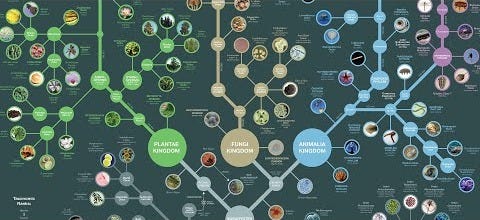
A critical point, often misunderstood, is that evolution progresses as a linear ladder from ‘lower’ to ‘higher’ forms. This is incorrect. Evolution is not a ladder; rather, it is a branching tree where each branch adapts to its specific environment. Therefore, the statement “humans evolved from chimpanzees or monkeys” is false. The correct statement is that humans and modern chimpanzees share a common ancestor that lived approximately six to eight million years ago (Langergraber et al., 2012). That ancestor species was neither human nor chimpanzee. It was a distinct population of primates adapted to its own ecological niche at that time.
The Cousin Analogy
To make this concept concrete, consider three individuals: Alex, Jordan, and their common grandfather, Samuel. Alex is physically very strong, able to lift heavy objects and endure harsh labor. Jordan is not strong but highly intelligent, using clever speech and problem‑solving to navigate social challenges. Samuel, their grandfather, possessed neither extreme strength nor exceptional cleverness. He had his own moderate abilities suited to his time and place. Alex lives in a rugged, physically demanding environment where manual power determines survival. Jordan lives in a complex social environment where negotiation and wit matter more than muscle. Samuel lived in a different environment altogether, one that required neither Alex’s raw strength nor Jordan’s verbal skill. Each uses what works in their own context.
Just as Alex did not descend from Jordan nor Jordan from Alex, both descend from Samuel. Similarly, humans and chimpanzees descend from a common ancestor that was neither human nor chimpanzee but adapted to its own environment. That ancestor was not a “missing link” between the two; it was a distinct species living its own life.
A Hypothetical Analogy
A more detailed analogy, based on a thought experiment about human groups living in contrasting environments, illustrates how natural selection drives divergence without any linear progression. Imagine two populations of modern Homo sapiens, both starting with identical genetic diversity and no technology beyond basic survival skills. Population A lives in a harsh environment: many predators, scarce food and water, extreme daily temperature swings (very hot days and very cold nights). Population B lives in a pleasant environment: abundant food, no predators, stable optimal temperature and constant mild light. Both populations remain completely isolated from each other for one million years, with no interbreeding.
Under evolutionary theory, after one million years, Population A would evolve traits favoring survival under stress. Natural selection would favor individuals with faster threat detection, more efficient metabolism to store fat during scarcity, better temperature regulation (e.g., efficient sweating and non‑shivering thermogenesis), and possibly smaller leaner body size to reduce caloric needs.
In contrast, Population B would evolve under relaxed selection. With no predators, genes causing hyper‑vigilance or chronic anxiety would be neutral or slightly detrimental because they waste energy. Abundant food would reduce selection for metabolic efficiency, possibly allowing larger body size. Constant pleasant climate would lead to loss of extreme temperature adaptations. Over time, Population B might become larger, softer, less fearful, and possibly even less intelligent because complex problem‑solving is not required for survival, as Darwin would argue (1859).
This analogy demonstrates that evolution is not progress toward a goal; it is local adaptation. Neither population is “more evolved” than the other. Each is well‑suited to its own environment. Similarly, the common ancestor of humans and chimpanzees split into two lineages, each facing different environmental pressures, leading to different adaptations.
Key Evolutionary Changes Since the Split
From the common ancestor with chimpanzees to modern Homo sapiens, several major morphological and behavioral changes occurred. First, bipedalism evolved. The human lineage adapted to walking upright on two legs, freeing the hands for carrying food and using tools. Fossil evidence from Australopithecus afarensis (the famous “Lucy” specimen dated to 3.2 million years ago) shows a pelvis, femur, and knee joint clearly adapted for habitual bipedalism (Johanson & Taieb, 1976).
Second, brain size increased dramatically. The common ancestor had a brain volume of approximately 350–400 cubic centimeters, similar to modern chimpanzees (Wood, 2010). Homo habilis (2.4 million years ago) had brain volumes of 550–700 cc. Homo erectus (1.8 million years ago) reached 900–1100 cc. Modern Homo sapiens average 1300–1400 cc. This tripling enabled complex tool manufacture, language, abstract thinking, and large‑scale social cooperation (DeCasien et al., 2017). Third, the human face and jaw became smaller and less prognathic. As humans began cooking food and using stone tools, selective pressure for large jaws decreased. The skull became more globular (Lieberman, 2011).
Next, the hand evolved a longer, more opposable thumb, allowing precision grips for fine tool use. Then, humans lost most body hair and evolved a dense network of eccrine sweat glands, an adaptation for endurance running and hunting during hot daylight hours (Bramble & Lieberman, 2004). Contrast this with chimpanzees, which retain thick body hair and cannot effectively cool through sweating. Also, the human gut and dentition changed: the large intestine reduced in size, and the small intestine became relatively longer, reflecting a diet increasingly dependent on cooked starches and meat (Carmody et al., 2011).
These six changes, from bipedalism to gut restructuring, collectively distinguish modern humans from our common ancestor with chimpanzees. Each adaptation solved a specific survival challenge, and together they illustrate how natural selection shapes a lineage over millions of years without any predetermined ladder of progress.
The chimpanzee lineage (genus Pan) also evolved significantly from the common ancestor, but in different directions. To begin, chimpanzees retained and refined arboreal adaptations. Their shoulder joints are more mobile than humans, allowing greater range of motion for climbing and swinging. Their finger bones are longer and more curved, which improves grip on tree branches (Richmond et al., 2001).
Next, chimpanzees evolved a specialized form of quadrupedalism called knuckle‑walking. They walk on the knuckles of their hands, which requires distinct wrist bone morphology (e.g., a large styloid process on the ulna) and muscle attachments that are absent in humans and in the common ancestor (Richmond & Strait, 2000). In addition to that, male chimpanzees developed large, sharp canine teeth used in aggressive displays and fights over dominance and mates. These canine teeth are relatively larger than those of the common ancestor as reconstructed from fossil hominids (Wood, 2010).
Another key change involved the digestive system, which adapted to a diet of raw fruits, leaves, insects, and occasional meat. Chimpanzees have a larger cecum and longer colon compared to humans, allowing fermentation of plant fiber (Milton, 1999). Furthermore, chimpanzees evolved complex social intelligence, including tool use (e.g., termite fishing with sticks, nut cracking with stones), coalitionary politics, and rudimentary cultural transmission across generations (Whiten et al., 1999).
However, unlike humans, chimpanzees did not evolve symbolic language or cumulative technological culture. In contrast to the human lineage, chimpanzees show no evidence of bipedalism, reduced canine teeth, or dramatic brain expansion beyond the common ancestor’s range. Their brain size remains around 350–400 cc, similar to the ancestral condition.
Why the Misconception Persists?
The misconception that humans evolved directly from chimpanzees or monkeys persists for several reasons. One reason is the “great chain of being” or scala naturae, an ancient philosophical idea that arranging life on a linear ladder from simple to complex, with humans at the top, is intuitive but incorrect (Lovejoy, 1936). Evolution is not a ladder; it is a branching bush.
Another reason is oversimplified diagrams in textbooks that show a sequence of fossils from a chimpanzee‑like form to a human, implying direct descent. In reality, those fossils represent extinct side branches, not a straight line (Wood, 2010). A third reason is that the media often uses phrases like “missing link” which wrongly suggest a single linear chain. In fact, the fossil record contains many transitional forms, but they do not form a single sequence from chimp to human. Instead, they form a complex bush of hominin species, most of which went extinct.
Conclusion
To summarize, evolution does not claim that humans evolved from chimpanzees or monkeys. The correct scientific view is that humans and modern chimpanzees share a common ancestor that lived six to eight million years ago. That ancestor was neither human nor chimpanzee but a distinct primate population adapted to its own environment. From that ancestor, two lineages diverged. The human lineage evolved bipedalism, large brains, reduced jaws, precision thumbs, and sweating for endurance running. The chimpanzee lineage evolved knuckle‑walking, curved finger bones, large canine teeth, and arboreal adaptations. Both lineages are equally “evolved” in the sense that both have been subject to natural selection for the same amount of time. Neither is ancestral to the other. Understanding this corrects a widespread error and clarifies how evolution actually works: as a branching tree of adaptation to local environments, not as a ladder of progress.
References
Bramble, D. M., & Lieberman, D. E. (2004). Endurance running and the evolution of Homo. Nature, 432(7015), 345–352.
Carmody, R. N., Weintraub, G. S., & Wrangham, R. W. (2011). Energetic consequences of thermal and nonthermal food processing. Proceedings of the National Academy of Sciences, 108(48), 19199–19203.
Darwin, C. (1859). On the origin of species by means of natural selection. John Murray.
DeCasien, A. R., Williams, S. A., & Higham, J. P. (2017). Primate brain size is predicted by diet but not sociality. Nature Ecology & Evolution, 1(5), 0112.
Futuyma, D. J., & Kirkpatrick, M. (2017). Evolution (4th ed.). Sinauer Associates.
Johanson, D. C., & Taieb, M. (1976). Plio–Pleistocene hominid discoveries in Hadar, Ethiopia. Nature, 260(5552), 293–297.
Langergraber, K. E., Prüfer, K., Rowney, C., Boesch, C., Crockford, C., Fawcett, K., … & Vigilant, L. (2012). Generation times in wild chimpanzees and gorillas suggest earlier divergence times in great ape and human evolution. Proceedings of the National Academy of Sciences, 109(38), 15716–15721.
Lieberman, D. E. (2011). The evolution of the human head. Harvard University Press.
Lovejoy, A. O. (1936). The great chain of being. Harvard University Press.
Milton, K. (1999). A hypothesis to explain the role of meat‑eating in human evolution. Evolutionary Anthropology, 8(1), 11–21.
Richmond, B. G., Begun, D. R., & Strait, D. S. (2001). Origin of human bipedalism: The knuckle‑walking hypothesis revisited. American Journal of Physical Anthropology, 116(S33), 70–105.
Richmond, B. G., & Strait, D. S. (2000). Evidence that humans evolved from a knuckle‑walking ancestor. Nature, 404(6776), 382–385.
Whiten, A., Goodall, J., McGrew, W. C., Nishida, T., Reynolds, V., Sugiyama, Y., … & Boesch, C. (1999). Cultures in chimpanzees. Nature, 399(6737), 682–685.
Wood, B. (2010). Reconstructing human evolution: Achievements, challenges, and opportunities. Proceedings of the National Academy of Sciences, 107(Suppl 2), 8902–8909.
Very well presented 😁 .